How Does Agentic AI Work in Business?

 B2B Innovations
 If you’ve spent any time in a boardroom or a LinkedIn feed lately, you’ve probably heard the term “agentic AI” thrown around like it’s the next big thing after generative AI. In a lot of ways, it is. But most explanations of the concept are either too technical or too vague to actually be useful. So let’s fix that.
This article explains how does agentic AI work in business in plain terms — what it actually does differently from the chatbots and copilots you’re already using, where it’s being deployed today, and what companies need to get right before handing over the keys to an autonomous system.
What Makes AI “Agentic” in the First Place
Most AI tools people use at work — ChatGPT, Copilot, Gemini — are reactive. You ask a question, they answer. You give an instruction, they follow it once, and then they wait for you again.
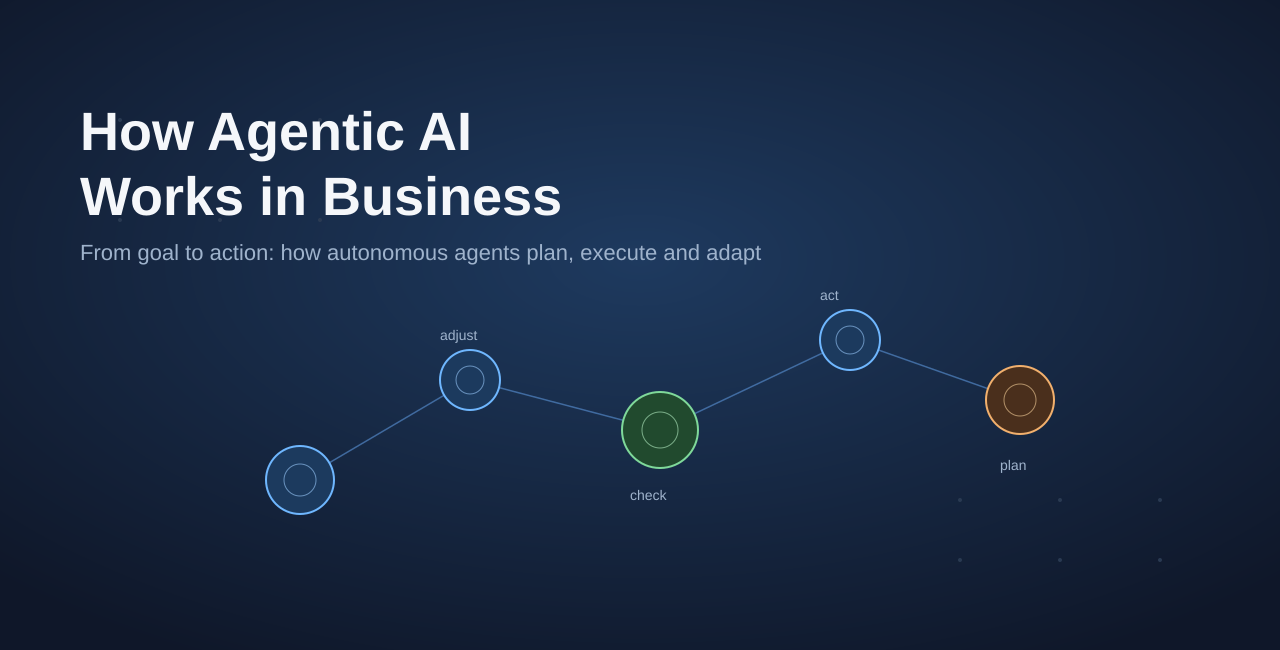
Agentic AI is different because it doesn’t just respond — it acts, and it keeps acting until a goal is met. Give it an objective, and it will break that objective into steps, decide which tools or data sources it needs, execute those steps, check whether the outcome matches the goal, and adjust course if it doesn’t.
Think of the difference between a very capable intern and a very capable employee. The intern does exactly what you ask, then stops. The employee gets the assignment, figures out the plan, pulls in resources, and comes back when the job is actually done — not just when one task is complete.
The Core Components
Under the hood, agentic AI systems typically rely on a handful of building blocks working together:
- A reasoning engine (usually a large language model) that plans and decides what to do next
- Memory — short-term for the current task, and sometimes long-term to retain context across sessions
- Tool access, so the agent can query databases, call APIs, send emails, or update software systems
- An orchestration layer that sequences multiple steps or even multiple agents together
- Feedback loops that let the system evaluate its own output and retry if something’s off
None of these pieces are new on their own. What’s new is stitching them together so the system can operate with meaningfully less human babysitting.
How Agentic AI Actually Works Step by Step
It helps to walk through a concrete example rather than stay abstract. Say a mid-sized retailer wants to automate parts of its customer refund process.
Step one: goal setting. A human defines the objective — “process eligible refund requests under $200 without manual review” — along with the guardrails (which criteria make a refund eligible, spending limits, escalation triggers).
Step two: perception and data gathering. The agent pulls the order history, return policy, and customer communication from connected systems. It isn’t working from a single static prompt; it’s actively retrieving what it needs.
Step three: planning. The agent decides the sequence: verify the order exists, check it against policy, calculate the refund amount, and determine whether it needs to flag anything unusual, like a customer who has filed five refund requests this month.
Step four: action. It executes — issuing the refund through the payment system, updating the CRM, and sending a confirmation email — without a person clicking “approve” at each stage.
Step five: monitoring and correction. If the refund system throws an error, or if the customer’s order doesn’t match the return policy cleanly, the agent doesn’t just fail silently. It either resolves the discrepancy itself or escalates to a human with context on what went wrong.
That loop — plan, act, check, adjust — is the mechanical heart of how agentic AI works in business settings, whether the use case is refunds, IT ticket resolution, supply chain adjustments, or recruitment screening.
Where Businesses Are Actually Using It
The hype cycle around agentic AI is real, but so is the deployment. A few areas stand out:
Customer Operations
Support and service functions were early adopters because the tasks are repetitive but rules-based enough for an agent to handle safely — password resets, order tracking, basic troubleshooting, and now increasingly first-pass resolution of billing disputes.
IT and DevOps
Agentic systems are being used to monitor infrastructure, detect anomalies, and in some cases automatically remediate issues — restarting a failed service, rolling back a bad deployment, or reallocating compute resources — before a human engineer even sees an alert.
Finance and Procurement
Invoice matching, expense approval workflows, and vendor risk checks are well suited to agentic automation because they involve clear rules combined with the need to pull data from multiple systems, something traditional rule-based automation always struggled with.
Sales and Marketing
Agents are increasingly used to research prospects, draft personalized outreach, schedule meetings, and update CRM records — chaining together tasks that used to require a human moving between five different tools.
Agentic AI vs. Traditional Automation vs. Generative AI
It’s worth being precise about the differences here, because the terms get conflated constantly.
| Type | How it works | Example |
|---|---|---|
| Traditional RPA | Follows fixed, pre-programmed rules | Move data from Excel to a CRM field |
| Generative AI | Produces content in response to a prompt | Draft a marketing email |
| Agentic AI | Plans, acts, and adapts toward a goal | Research a lead, draft the email, send it, follow up if no response |
Traditional robotic process automation (RPA) breaks the moment something outside its script happens. Generative AI is powerful but passive — it waits for you. Agentic AI sits between reasoning and execution, which is exactly why it’s harder to build well and riskier to deploy carelessly.
The Governance Problem Nobody Wants to Talk About
Here’s the part that gets glossed over in most vendor pitches: an agent that can act autonomously is also an agent that can make autonomous mistakes, at scale, faster than a human would ever notice.
If a traditional software bug fails, it usually fails loudly and stops. An agentic system can confidently execute the wrong plan repeatedly, updating records, sending communications, or moving money, before anyone realizes the goal was misinterpreted. That’s not a hypothetical risk — it’s the direct consequence of removing the human checkpoint that used to exist between decision and action.
This is why the conversation around agentic AI can’t just be about capability — it has to be about governance from day one: who defines the agent’s boundaries, how its decisions are logged, what triggers human review, and who is accountable when it gets something wrong. We’ve written in more depth about why treating AI adoption as a governance challenge rather than just a technology rollout tends to separate the organizations that scale AI successfully from the ones that end up rolling it back after an embarrassing failure.
Practical governance steps that matter in real deployments include:
- Defining clear decision boundaries before deployment, not after an incident
- Logging every action an agent takes, not just its final output
- Setting spending, communication, or system-access limits per agent
- Building in human-in-the-loop checkpoints for high-stakes or irreversible actions
- Running regular audits comparing agent decisions against policy intent
What This Means for Business Leaders Right Now
You don’t need to deploy fully autonomous agents across your organization tomorrow, and frankly, most companies shouldn’t. The businesses seeing real value tend to start narrow — a single well-defined process, clear success metrics, and tight guardrails — before expanding scope.
It’s also worth watching how the underlying industry is organizing itself around standards and safe deployment practices; resources like agentic.ai track the broader ecosystem of frameworks and tools emerging to support this shift, which is useful context if you’re trying to separate genuine capability from marketing noise.
The technology is genuinely capable of removing friction from processes that have resisted automation for decades. But the businesses getting real value aren’t the ones chasing the flashiest demo — they’re the ones being deliberate about scope, accountability, and what happens when the agent gets it wrong.
Key Takeaways
Agentic AI works by combining reasoning, memory, tool access, and feedback loops so a system can pursue a goal rather than just respond to a single prompt. It’s already running in customer service, IT operations, finance, and sales functions today — not in some distant future. The businesses succeeding with it treat governance as a design requirement, not an afterthought bolted on after something breaks.
If you’re evaluating where agentic AI fits into your operations, start small, define your guardrails before you define your ambitions, and build the oversight structure alongside the technology — not after it.